What Does 2000 Calories Actually Look Like?
A visual side-by-side comparison of 2000 calories across whole foods, fast food, snacks, drinks, and home-cooked American meals — you might be surprised.
The number 2000 is everywhere. It’s on every nutrition label, every chain restaurant menu, and baked into the ”% Daily Value” on every packaged food you’ve ever picked up. But if someone asked you to actually picture 2000 calories of real food — could you?
Most people can’t. And that’s not a failure of willpower or education — it’s because calories are invisible. A handful of nuts and a massive plate of vegetables can contain the same number of calories, but they look nothing alike.
This article is a visual reference. No judgment, no prescriptive advice — just a concrete, side-by-side look at what 2000 calories actually looks like across different types of food.
Why 2000 Calories?
The 2000-calorie figure comes from the FDA. In the 1990s, when the Nutrition Facts label was being designed, the agency needed a single reference number for daily calorie intake. After surveying food consumption data, they settled on 2000 as a round number that roughly approximated the average American’s intake.
Important context: 2000 calories is a reference value, not a recommendation. Your actual needs depend on your age, sex, height, weight, and activity level. A 5’2” sedentary woman might need 1,600 calories. A 6’1” active man might need 2,800. The 2000 figure exists so nutrition labels have a consistent benchmark — nothing more.
It’s a useful anchor point, though. Once you know what 2000 calories looks like in different foods, you develop an intuition for calorie density that stays with you — regardless of what your personal target is.
2000 Calories in Whole Foods
A full day of balanced whole foods spread across three meals and snacks reaches 2000 calories comfortably — and it’s a lot of food.
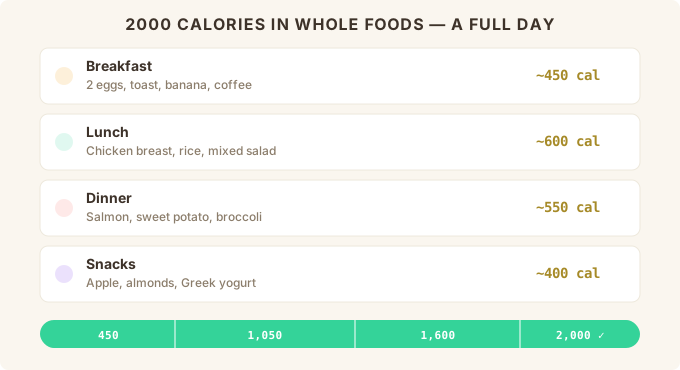
The thing that stands out: when you’re eating mostly whole, unprocessed foods, 2000 calories is genuinely hard to under-eat. Three meals and a couple of snacks, and you’re there. The food volume is substantial — you’re eating full plates at every meal.
This is why whole foods are often called “self-regulating” — the fiber, water content, and protein create natural satiety signals before you’ve overeaten.
2000 Calories in Fast Food
Now the same 2000 calories, but from fast food. The picture changes dramatically.
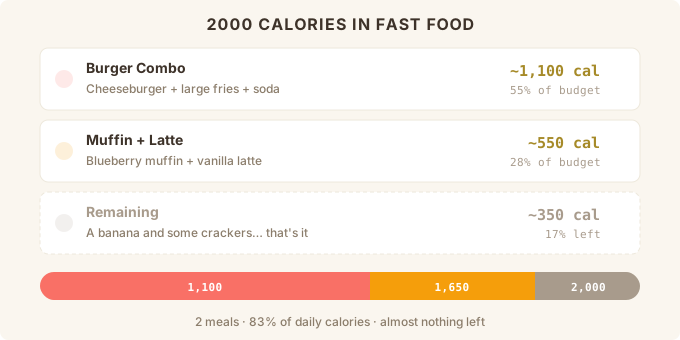
A single burger combo — burger, fries, and a soda — can account for over half your daily calories in one sitting. Add an afternoon muffin and latte, and you’ve already hit 1,650 calories with only two “meals.” That leaves just 350 calories for everything else — roughly one banana and a handful of crackers.
The calorie density of fast food is the core issue. The food volume is small relative to the calorie count. Your stomach isn’t full, but your calorie budget is spent.
A fast food burger combo has roughly the same calories as an entire day of breakfast, lunch, and snacks made from whole foods. The difference is you’re still hungry after one.
2000 Calories in Snacks & Drinks
Perhaps the most eye-opening comparison: how quickly snacks and drinks — things most people don’t even think of as “meals” — add up.
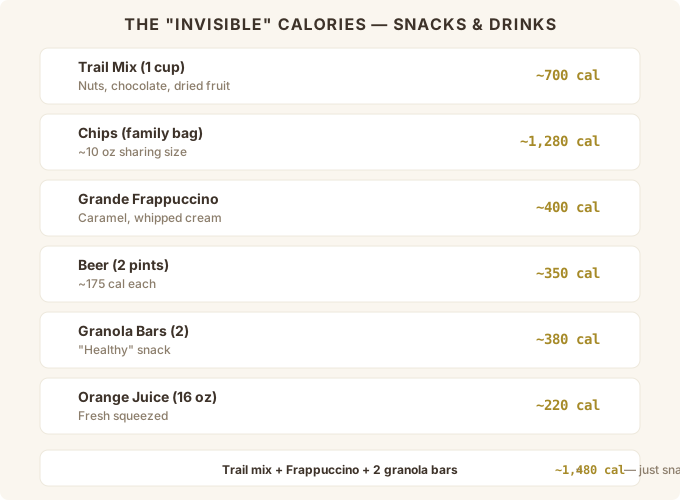
A cup of trail mix is ~700 calories. A family-size bag of chips, which plenty of people graze through over an evening, is ~1,280 calories. A Grande Frappuccino is 400 calories — the equivalent of a full meal, consumed in 10 minutes through a straw.
These are the “invisible” calories. They don’t feel like eating. There’s no plate, no fork, no sit-down meal. But calorically, they’re significant.
The Liquid Calorie Problem
Liquid calories are particularly easy to overconsume because they don’t trigger the same satiety signals as solid food. A 2021 review in Physiology & Behavior found that calories consumed in liquid form produce less fullness and less caloric compensation at subsequent meals compared to the same calories in solid food.
Two beers (~350 cal), a morning latte (~250 cal), and an evening glass of juice (~120 cal) add up to 720 calories — more than a third of a 2000-calorie day — from beverages alone.
2000 Calories in Home-Cooked American Meals
Here’s what a typical day of home-cooked American food looks like at ~2000 calories. These are normal portions — not diet food, not excessive — just regular meals.
| Meal | Items | Approx. Calories |
|---|---|---|
| Breakfast | 2 scrambled eggs, 2 strips of bacon, toast with butter, OJ | ~550 cal |
| Lunch | Turkey & cheese sandwich, handful of chips, apple | ~600 cal |
| Afternoon snack | Granola bar + coffee with cream | ~250 cal |
| Dinner | Grilled chicken thigh, mashed potatoes, green beans, roll | ~650 cal |
| Total | ~2,050 cal |
A few things to note:
- Cooking fat matters a lot. The same chicken breast can be 165 calories (grilled) or 300+ calories (pan-fried in butter). Cooking method is the single biggest variable in home cooking.
- Condiments add up. Two tablespoons of ranch dressing is ~130 calories. Mayo on a sandwich adds ~100. These extras are easy to overlook.
- Portion creep is real. A “normal” serving of mashed potatoes at home is often 1.5–2 cups — that’s 300–400 calories before you add butter or gravy.
The butter & oil variable: A tablespoon of butter is ~100 calories. Most home cooks use 2–3 tablespoons across a day’s cooking without measuring. That’s 200–300 “invisible” calories that never show up on anyone’s mental tally.
2000 Calories in a Single Item
Some individual food items get remarkably close to 2000 calories on their own:
- Cheesecake Factory Original Cheesecake (1 slice): ~1,500 calories
- Large movie theater popcorn with butter: ~1,200 calories
- A full Domino’s medium pepperoni pizza (8 slices): ~1,840 calories
- Chipotle burrito (rice, chicken, cheese, sour cream, guac): ~1,100 calories
- Venti White Chocolate Mocha with whipped cream: ~580 calories
- IHOP Mega Monster Cheeseburger: ~1,940 calories
None of these are meals most people eat instead of other meals. The Cheesecake Factory slice is dessert — after a 1,000+ calorie dinner. The movie popcorn is a snack. The Chipotle burrito is lunch, followed by dinner a few hours later.
That’s the pattern: the highest-calorie single items tend to be consumed in addition to regular meals, not as replacements.
What Actually Fills You Up: Volume vs. Density
This is the most important visual comparison in this article. Same calories, radically different food volume.
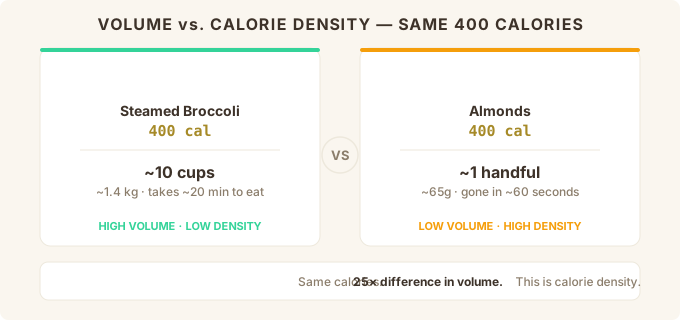
At 400 calories, you get either:
- ~10 cups of broccoli (steamed, ~1.4 kg of food) — a genuinely enormous plate that would be physically difficult to finish
- ~65g of almonds — roughly a small handful, gone in 60 seconds
Both contain 400 calories. But the broccoli has 25x the volume, takes 20 minutes to eat, and contains massive amounts of fiber that triggers stretch receptors in your stomach. The almonds are calorie-dense, nutritious, and satisfying in their own way — but they don’t fill the same physical space.
This isn’t about “good” vs. “bad” foods. Almonds are excellent nutrition. The point is simpler: calorie density varies enormously across foods, and understanding that variation gives you practical options.
Calorie Density Spectrum
Here’s roughly how foods stack up by calorie density:
| Category | Calories per 100g | Examples |
|---|---|---|
| Very low | 10–30 cal | Lettuce, cucumber, celery, broth |
| Low | 30–80 cal | Most vegetables, berries, melon |
| Medium | 80–150 cal | Fruits, lean protein, legumes, rice |
| High | 150–400 cal | Bread, cheese, meat, avocado |
| Very high | 400–600+ cal | Nuts, oil, butter, chocolate, chips |
People who feel hungry on a calorie budget often aren’t eating too little — they’re eating calorie-dense foods that don’t take up much stomach space. Shifting even one meal toward the lower end of the density spectrum can make a noticeable difference in satiety without changing total calories.
The Takeaway
2000 calories is a fixed number. But what it looks like varies wildly depending on what you’re eating. A full day of whole-food meals, or a single fast food combo plus a snack and a coffee. Ten cups of broccoli, or a small handful of nuts. A day of home-cooked American meals, or one slice of cheesecake.
None of this is about restriction. It’s about awareness. When you can look at a plate of food and have a rough sense of where it falls calorically, you make more informed choices — whatever your goals are.
The gap between “what you think you ate” and “what you actually ate” is where most confusion about food and weight lives. Closing that gap — even partially — is the single most useful thing you can do for your relationship with food.